
Of logos and heraldry
A few months ago, an article in WWD stated that the use of logos has become essential for an era that now looks with suspicion at minimalism and applauds maximalism. We don't need to explain why at La Condesa we are more fashionable than ever. True to our origins, far from such minimalism, we love the use of rich fabrics, prints, and accessories in line with our stylistic argument. With URO, we consolidate our commitment to this trend, logomania, not only with the use of the full brand name on some of the garments for this autumn but also with the most recognized symbol among our followers.

Marina Conde, our Creative Director, explains it perfectly: "We like to use the crown, the symbol of our brand, on many of our garments because it also perfectly represents the pillars on which La Condesa is built: rock&roll, aristocracy, and military style. This season, the star of this incorporation of our logo is the Corona suit, with a jacket and trousers embroidered with the nine-pointed crown."

Crowns that turn these garments into authentic jewels, as each of them has been carefully embroidered onto the fabric in Castilian lands, because we are loyal to proudly made in Spain.

And thinking about it, could the origin of logomania be in heraldry? Let's get a little illustrative to demonstrate that this theory is perfectly illustrated. Heraldry is the science of blazon (according to the RAE, "blazon" is defined as the "art of explaining and describing the coats of arms of each lineage, city or person"). This artistic discipline developed during the Middle Ages throughout Europe until it became a coherent code for identifying people, progressively incorporated by sectors of feudal society such as the nobility and the Catholic Church for the identification of lineages and members of the hierarchy, being equally adopted by other human groups, such as guilds and associations, in addition to being adopted for the identification of cities, towns and territories.

URO, inspired by Francis Ford Coppola's film Bram Stoker's Dracula, is a resounding tribute to heraldry as an artistic expression of royal dynasties.
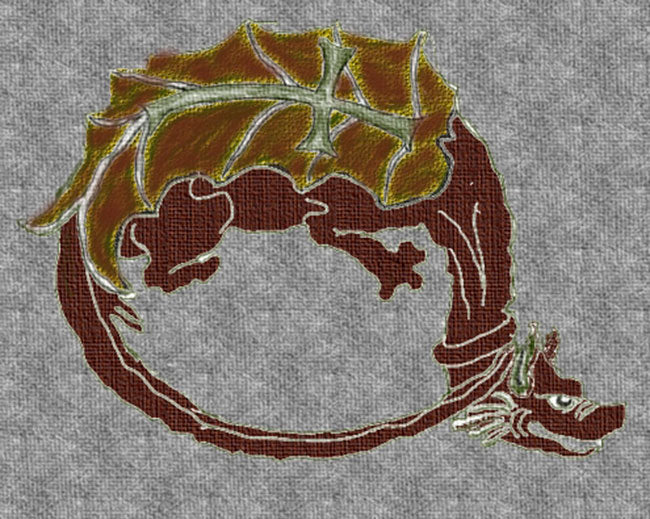
The Order of the Dragon was one of Bram Stoker's inspirations for the novel that gave rise to the film. This order was founded by Sigismund of Hungary and his wife Barbara of Celje, as a lay chivalric order. Its statutes called it a "society" and its members bore the symbol of the dragon, although it was not named. The statutes explain the symbols of the order: the ouroboros and the red cross, which were carried by its members and gave identity to the order.
The ouroboros is a symbol that shows a serpent-like animal swallowing its own tail and forming a circular shape with its body. In this order, the dragon was presented as an ouroboros with the red cross of Saint George on its back.
In our Heraldic line of the URO collection, the first to be available on our website this season, these and other elements have been incorporated into shirts and dresses, made 100% of silk, and have been mixed with our house's own symbols.
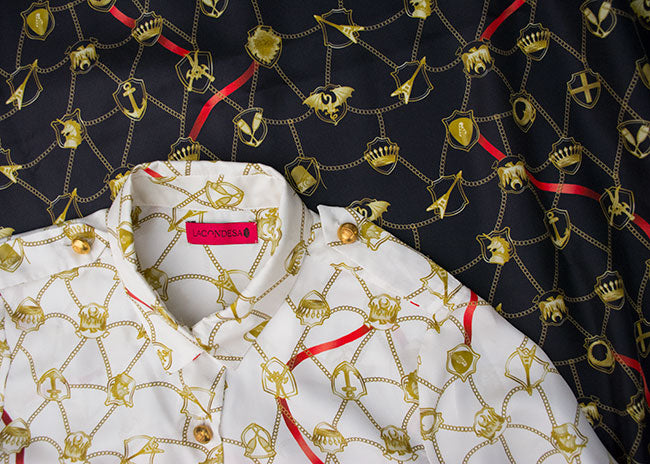
So what looks like a beautiful print at first glance is a conglomeration of heraldry and symbols, in which you can find:
- Crowns and anchors, as emblems of the brand.
- Thimbles, symbolizing our connection to craftsmanship and good work.
- Guitars and picks, rock&roll is a very important part of our DNA.
- Swords and shields, representing elements of the Order of the Dragon, linked to our military heritage.
- Dragons, ouroboros, and unicorns, bestiary of La Condesa and Dracula.
All of this with gold as the main color, our corporate color (we will talk about this in another post), and the red of the Order of the Dragon.

And so ends the beautiful story of how heraldry and logomania go hand in hand to become one of the most present trends this season. You won't have to navigate oceans of time to get any of our garments; just visiting our website will solve it for you.