
January 03, 2012
Living in the city
Last month, I was lucky enough to attend one of the meetings of the "Living the city" club, an exclusive leisure and experience club for women. When they told me about it, the image that came to mind was of ladies' clubs, sitting around a large table of green tea and €25 salads, chatting about the upcoming charity events they were going to support, at around €1,000 per plate.
Luckily, the lovely organizers of "Living the city" dispelled my images of mission collection boxes and told me that it's something more practical, an opportunity to meet and network with other professional women within the framework of a fun or interesting experience.
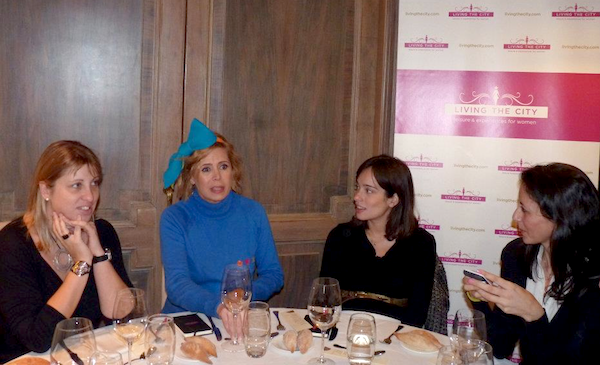
In my case, I was able to attend a talk and lunch with the designer Agatha Ruiz de la Prada, where all the attendees had the opportunity to meet and interview her in person. I confess that I went with certain preconceived ideas about her. Initially, she wasn't someone I was dying to meet, as I particularly like to ask about the business aspects involved in creating a company, and I mistakenly thought that Agatha would focus on the creative side.
Luckily, I was seated next to her, and I must say that within a few minutes I felt completely captivated by her personality. She is smart, very smart. Don't think that just because she wears a flower pot on her head, she doesn't have a clear idea of things or lives floating in a cloud—not at all. She gave us some pearls of wisdom that I will try to summarize, and which caused consternation among the attendees due to how clear and far removed from the overly sentimental discourse that perhaps some, more than just me, were expecting.
The attendees, mostly great admirers of Ágatha's work, focused their questions on her creative world, her imagination, and the exuberant colors with which she imbues everything. She answered patiently but with a loud and clear discourse, emphasizing that the secret for a company to work relies on two key concepts: accounting and knowing how to sell.
Horrified, the attendees asked her how someone so creative could be attracted to accounting. Agatha told us that when she was in her twenties, she went completely broke, and since then she learned that accounting is the best antidepressant there is because, while you're working on it, you're so engrossed that you can't think of anything else, and time flies by. She admitted that the first thing she did every day when she arrived at her office was to review the previous day's sales statement.
Here's the second secret: for her, the most admired quality in anyone in this world, no matter what they do, is knowing how to sell, because if you know how to sell, it doesn't matter if you sell roof tiles, cars, or colorful jackets, you won't starve. Tell me if this isn't an overflow of common sense that was unexpected but deserves admiration, at the very least.
She told us that for her, work has many positive connotations; for her, it is happiness, quite contrary to what she was instilled with in the bourgeois and affluent family she comes from. She commented that until not long ago, in the Spanish upper classes, it was not well-regarded to work, but rather to live off one's rents, as was generally the case in this old Europe that has had to wake up to the American model of working and talking about money quite naturally, and perhaps part of the crisis we are experiencing comes from this deeply rooted sentiment in many.
Being a women's club, it was inevitable that the topic of motherhood and work-life balance would come up. I must say that at this point, Agatha not only interested me but also made me laugh out loud when, listening to one of the attendees' pessimistic discourse on the matter, she stared at my pregnant belly and said, "You, pay no attention to this, huh? Turn a deaf ear, because you can do it." The reply to the pessimist came from an entrepreneur who shared her recent motherhood experience, which had required extra effort but was clearly more positive and motivating than the previous one. As I listened, Ágatha again turned to me and recommended, "Her, her, you only talk to her."
Then it was Ágatha's turn to present her vision on motherhood, family, and work. Right from the start, she blurted out that the current obsession with family, with everyone together, children on top of you all the time, and so on, is a bit...provincial, to put it one way. From my seat, I could see the horror reflected on the faces of the happy, suffering mothers, and I had to make a real effort not to burst out laughing. She confessed that in her circles, it had been quite common for parents and children to have a cordial but not overwhelming relationship, that carrying children around all the time was something she had seen in country folk, and she was surprised how that custom had become so deeply rooted as to almost turn into slavery for modern women.
For her, her family had been important, but even more so had been people with whom she had no blood ties, and who had nevertheless provided her with support and connection beyond her official relatives. That's why she thought it was important to instill in her children the capacity and ability to behave well in the presence of strangers, as she wanted them to learn to be happy beyond the limits of the family.
I imagine that to some, it sounds scandalous, but I assure you it was a very sensible, stereotype-free, and sincere discourse. However, some of the attendees must not have assimilated it well because the next question was about how she had managed to combine creating the company with her children's school tasks. Here, I think Agatha lost a bit of patience when she saw that her previous discourse had not been understood at all, and she snapped a resounding "I never liked doing school tasks, neither my own nor certainly my children's, so when it was time to do their homework, I sent them to a boarding school in England." I burst out laughing, and I still remember it. What a boss.
I left the meeting refreshed, I promise you; I still laugh when I remember some of the comments. You may or may not agree, but it is certainly appreciated when someone takes a risk and steps outside the omnipresent discourse of "being a mother is the best job in the world" that we have had to live with in this century. Perhaps in a few months, I will surprise you with the news that I am hanging up my tape measure and scissors and dedicating myself only to the heiress, but given how much it has cost me to fulfill my dream and live from my own company, I hope to have the good sense to learn to raise the little one among fabrics and not cotton wool. We'll see.
Until then, working mothers, entrepreneurial mothers, much encouragement, much sense of humor (even scandalous), and no guilt.
A thousand hugs,
La Condesa living the city